Wednesday, January 22, 2020

A Flight of Butterflies

Still many days until the butterflies return, but how about a few beaded ones to brighten a wintery day?

The first three shown are from an ebook, Brick-stitch Beaded Butterflies by Karen Parker --

a Crimson Callicore:   

a Blue Morpho:


and lightly tacked down on my straw hat -- an Apollo butterfly:


So far, as you can see, I've only managed to put the Apollo to good use.  The Blue Morpho has always been meant to be transformed into a necklace -- but I have been stuck in a design rut as to how to finish it off.  My first thought was a silk ribbon, but then doubts crept in and there it sits.

The Crimson Callicore may end up as an ornament on a clutch, similar to how I used the last butterfly -- an anonymous figment of my imagination:


This one has been embroidered onto a backing of wool felt and sewn on to the flap of a little raw silk clutch I made. I'm sure I had some type of pattern (at least for the shaping) but I no longer remember where it might be from. 

I have beads to make a couple more -- there's something very relaxing and meditative about making them -- but I'd really like to find a better way of admiring them than atop a thread cabinet in the sewing room. Still, they do spark joy!


Tuesday, January 7, 2020

The miracle of blocking

I'm in the midst of knitting up a lace scarf - Star and Pine, by Anne Hanson - which is done in two separate pieces and then grafted together in the middle.  Yarn is a lovely blend of Blue Faced Leicester, silk and cashmere from Yarn Hollow in the White Pine colorway. It was one of the November projects from Knitspot's Fall in Full Color 2013 - and yes, it's taken me a good bit of time to get around to it!

It's taking me a while to finish up the second half, so I decided to do a little blocking of the first half to get a better idea of what to expect of the finished size.  If ever there's a type of knitting that transforms with blocking it's lace.


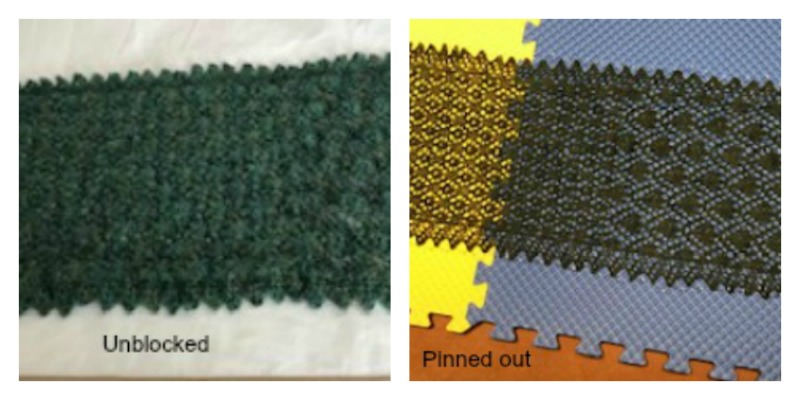
The first (out of focus) pic shows just how crumpled up and hard to visualize the pattern that unblocked lace can be.  In the second pic I have soaked (in Eucalan) and spun out the scarf half and pinned it out on a couple of foam blocks.  Mine aren't "official" blocking squares, but some I picked up at Costco many years ago.  Work just fine for blocking. The process would have been easier if I had been able to find my blocking wires -- I would have run a wire through each edge point instead of laboriously pinning everything, but can't find them since our move. Sigh. When I block the other half I'll probably run a sturdy crochet cotton cord through the points if the wires still haven't appeared. It won't be as easy as using the more rigid wires, but will be easier, and probably more even, than pinning.

And here's a closer look:


It transitions from tree shapes to a different pattern as it approaches the back neck.  I suspect they appeared star shaped to the designer (hence the pattern name), but they look more flower like to me. Regardless, I think it will be a lovely scarf when I finish!


Monday, December 23, 2019

Teesdale scarf

Another little crochet project -- this one made in Sundara Yarn Sport Merino that's been marinating in the stash for a good bit.

The pattern is by Rebecca Velasquez and was a quick and easy project.  Once I had the pattern memorized it went quickly and could be done while conversing or watching TV. Just the thing to take the sting out of my previously mentioned failed knitting project.

It's scarf sized, rather than a full on shawl, which was just what I needed for the two skeins of Sport Merino (100 g, 225 yards each) that I had.  I think the yarn I used was just a bit heavier than called for in the pattern, and I went up in hook size to account for that.  I ended with a few yards to spare, so that was a relief.

Here's another closeup look: 


Lovely yarn in a scrumptious color (Reaching Out) and a fun to make pattern -- just what the fiber doctor ordered!


Wednesday, December 18, 2019

A Little Crochet

I needed a quick and easy project after hitting a major roadblock in my knitting, so I dug out a skein of luscious baby alpaca and silk (Lorna's Laces Honor) and whipped out the Iced Ascot by Rebecca Velasquez from the book Simply Crochet by Robyn Chachula. I liked Rebecca's pattern enough to do a pattern search of her other designs on Ravelry, and ended up purchasing her Teesdale small shawl/scarf pattern which I'm working on now.


The colorway is Loopy Ewe Shuffle, which leads me to believe it was a one off from The Loopy Ewe, no longer available I'm sure, as it's been in the stash for quite a while.

It was a nice palate cleanser after the heartbreak of running out of yarn for a sweater from a kit, purchased a while back, from a merchant that is no longer in business, and a yarn made specifically for that designer...well, you get the idea. I've been working on it for at least a year, and I was gutted to be unable to finish it off. Sigh.

There has been knitting though -- of the machine variety -- several hats for donation which were knitted on the LK-150. No photos, as they're pretty Plain Jane, but I did have a "D'oh" moment when mattress stitching them up.

I was having trouble seeing where to place my sewing needle to continue a straight seam after pulling the working yarn taut to snug up the stitches.  So I had the bright idea (or so I thought) to put a little marker in the place where I needed to place the needle after snugging up -- like so:  


Worked a charm, but the clever among you will grasp the "D'oh" reaction -- I could have simply placed my needle there before pulling the working yarn taut and been ready for my next stitch in the proper position. Oh well, I felt smart for a moment, anyway!


Wednesday, December 11, 2019

Beading progress

Taking a little break from fabric and fiber to play with beads. I'm waiting for findings to arrive in order to finish them up, but progress so far is pleasing to me.

Both patterns are from Deb Roberti's Around the Beading Table and both are free patterns -- Petite Paisley earrings and Astral bracelet. There are many attractive patterns on her site, both free and to purchase. I have made several of the free patterns, and purchased a couple of others, and what stands out to me about Deb's patterns is the clarity of her instructions. The written instructions are clear and concise, and her diagrams help even a beginner beader like me achieve good results.

I used Zoli Duo (both right and left facing) in Pastel Purple for the earrings and the seed beads are silver-lined crystal. Ran out of jump rings in the size/finish I wanted to use to attach them to ear wires, but it should be a quick finish once they are in hand. 


The bracelet is made with CzechMates 2-hole 7mm beads in Metallic Aurora Red, with 11/0 seed beads (Miyuki Silver Lined Grey) and 3mm fire polished crystal beads.


I was trying for a look of antique silver with the grey seed beads, and I think it comes fairly close. This one is waiting on a clasp. 


Monday, December 2, 2019

Warm gravy

Here's a quick tip I wish I'd known many holiday meals ago.  Instead of that attractive gravy boat that let's your sauces go cold and congealed halfway through your meal -- try using an insulated coffee carafe.


I like this one (NOT an affilliate link) but there are plenty out there that would serve just as well I'm sure. Just pre-heat with boiling water about an hour before you want to use it, then sit back at the dinner table and let everyone enjoy piping hot gravy without you having to jump up and re-heat during the meal.  I've been told by the clean-up crew (DH) that ours was still steaming when leftovers were being packed up. 


Thursday, November 21, 2019

Straighten Up!


Keeping the edges straight on a piece crocheted in dc (double crochet - US terminology) can be a challenge, especially if (like me) you learned to chain 3, count that as a stitch, skip the next chain and proceed down the row. From the first photo you can see that there is a small gap between the chain 3 and the next crocheted stitch.

Later on I learned that some crocheters made the same chain 3 to begin a new row, but did NOT count the chain as a separate stitch -- it was merely a bit extra at the edge.  This took care of the unsightly gaps, but that extra bit gave the edges a wavy, or scalloped, look as you can see in the middle photo.  That's not always a bad look, but for those times when you'd prefer a straighter edge I've found a method that works fairly well -- it won't be razor straight -- but it will be a neater edge.

Photo 3 illustrates this newer method. I've seen it referred to as a "stacked" method and since that makes sense to me that's what I'll call it.  There may be other names though! I don't know who came up with this first, so I can't give credit, but I can give thanks to whoever it was -- it's fairly simple, and it really helps straighten things out!  (Click photos for larger image)


For the stacked method, you do not chain anything at the end (or beginning) of your dc row. You simply turn the work, and in the very first stitch make a sc (US terminology) in that stitch in the usual way.  See photo a) for where to begin, see photo b) for first sc made.

Now in the sc that you just made you will insert your hook into the LEFT (as facing you - photo c)) leg of that sc and work another sc.  So, hook into left leg, yarn over hook, pull through --2 loops now on hook -- yarn over hook again and pull through both loops on hook. This gives you the effect of two sc stitches, one sitting atop the other.


Photo d) shows the completed "stack". From here you continue the row as usual. You will have noticed that this method was illustrated on a piece that had already been started.  But how do you do this if you want to start from the very beginning chain? The answer -- I don't know, I've never done it that way.  I had read a hint somewhere to make the very first row of your project in sc and that seemed much more sensible (to me) than trying to wrangle this stacked dc into a beginning chain. You may feel differently, so experiment -- nothing to lose but a bit of time!